
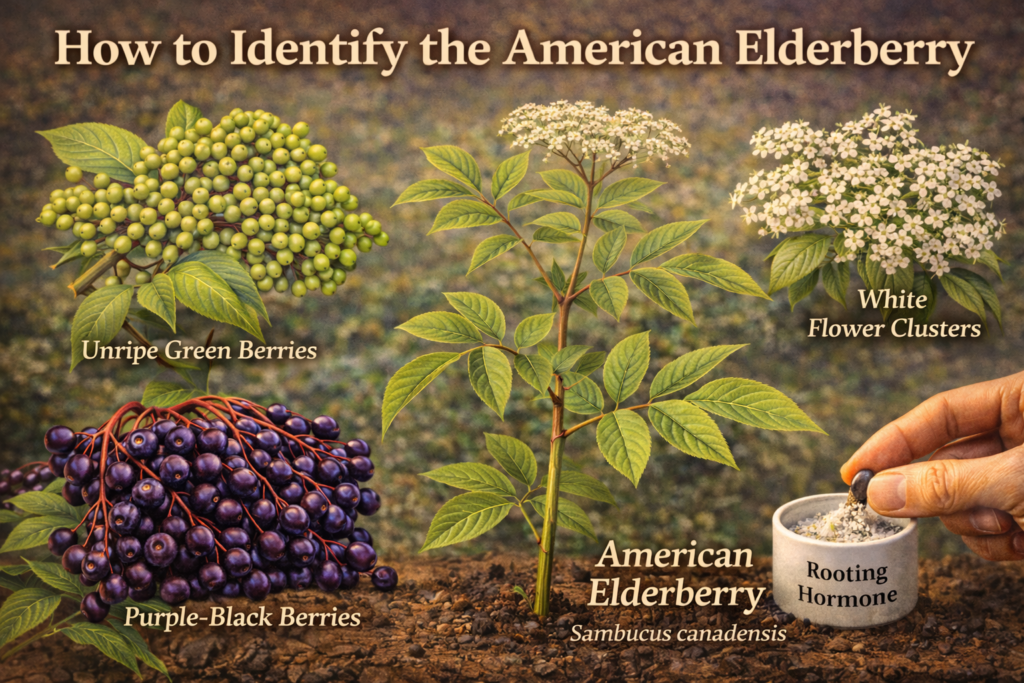
If you’re planning to grow elderberries—or you’ve spotted a shrub and think it might be one—learning how to identify the American elderberry is an important first step. American elderberry is commonly known as Sambucus canadensis (also often classified as Sambucus nigra subsp. canadensis), and it has a few clear features that make it easier to recognize once you know what to look for.
The key is to identify the plant by a combination of traits: leaves, stems, flower clusters, berry clusters, and overall growth habit. Don’t rely on just one feature.
Start with the plant’s overall shape
American elderberry is usually a multi-stemmed shrub rather than a single-trunk tree. It often grows in a loose, spreading form and can become fairly large if left unmanaged. In many places, it appears along field edges, roadsides, streambanks, and moist open areas.
A mature plant often looks a little wild and natural in shape, with several canes rising from the base.
Look at the leaves
One of the easiest clues is the leaf structure. American elderberry has compound leaves, which means each leaf is made up of multiple leaflets arranged along a central stem.
What to look for:
- Leaflets usually appear in opposite pairs
- Leaves commonly have 5 to 11 leaflets
- Leaflets are usually oval to lance-shaped
- Edges are serrated (toothed)
This gives the foliage a feathery, layered look compared with shrubs that have simple leaves.
Check the flowers (a major clue)
When in bloom, American elderberry is much easier to identify. It produces large, flat-topped clusters of many small flowers (often creamy white to white).
These flower clusters:
- are broad and somewhat umbrella-like
- sit at the ends of branches
- are made up of many tiny flowers packed together
This flat cluster shape is one of the most recognizable elderberry traits.
Check the berry clusters
After flowering, the plant develops clusters of small berries that ripen from green to deep purple-black (depending on maturity and variety). The berries grow in hanging clusters after the flowering stage.
The clusters often become heavy as fruit ripens, which can make them droop.
Important note for identification: unripe berries are green/reddish before they darken, so color alone is not enough unless the fruit is fully mature.
Look at stems and branching pattern
American elderberry stems are often:
- somewhat soft when young
- woody with age
- arranged in a branching shrub form with multiple canes
Another clue many growers notice is that older stems can have a pithy center (soft inner tissue), which is common in elder types.
Habitat can help (but shouldn’t be your only test)
American elderberry often prefers:
- moist soil
- sunny to partly sunny areas
- edges of woods, ditches, creeks, and open land
If you find a shrub matching the leaf and flower/berry description in a moist area, elderberry becomes more likely—but always confirm using multiple features.
Common mistakes and look-alikes
The biggest identification mistake is matching only the berries or only the leaf shape. Some other plants can produce dark berries or compound leaves, but the full combination of elderberry traits is what matters.
Pay special attention to:
- flower cluster shape (flat-topped clusters are a strong clue)
- compound leaves with serrated leaflets
- multi-stem shrub growth habit
- berry clusters following the flowers
If you are ever unsure, avoid harvesting or consuming anything until the plant is confidently identified.
Seasonal identification tips
American elderberry can look different through the year, so it helps to know what stage you’re seeing:
- Spring: fresh compound leaves emerge
- Early summer: flat clusters of white flowers appear
- Late summer: berries develop and darken as they ripen
- Fall: foliage declines and structure becomes easier to see
- Winter: identification is harder without leaves/flowers/berries, so branch structure alone may not be enough for beginners
Final thoughts
The best way to identify the American elderberry is to use a full checklist, not a single feature. Look for a multi-stem shrub with compound serrated leaves, broad clusters of small white flowers, and later clusters of dark berries.
Once you start noticing these patterns together, elderberry becomes much easier to recognize in the field or in a planting row. And if you’re planning to grow it, learning identification early helps build confidence long before harvest season.