
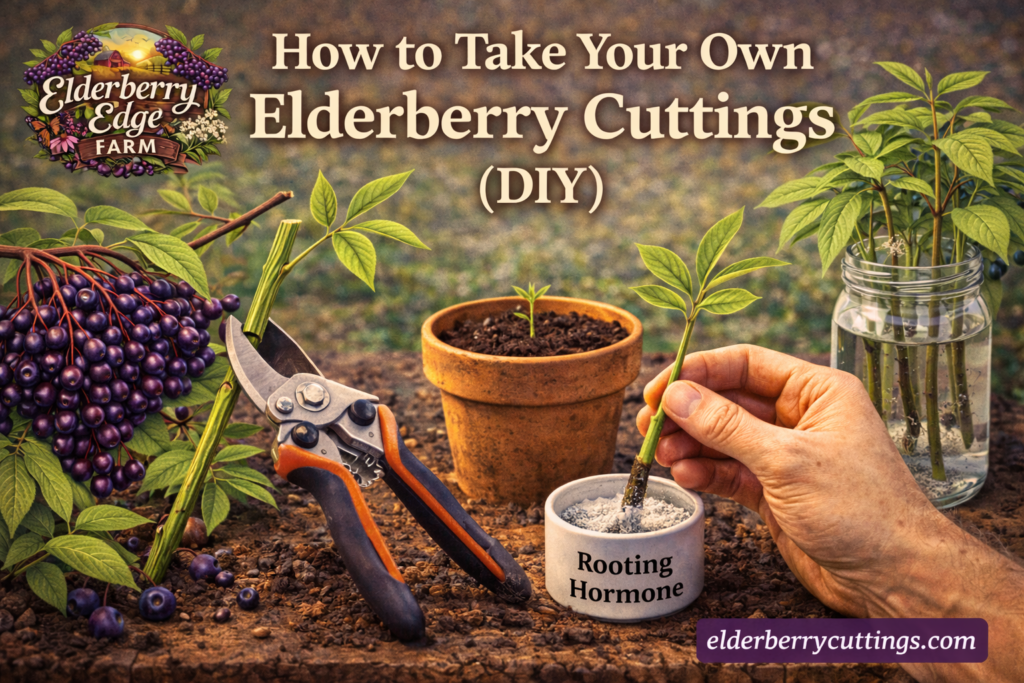
If you want a practical and affordable way to grow more elderberry plants, taking your own cuttings is one of the best methods. It’s a classic DIY approach: simple tools, a little patience, and a much faster path than growing elderberry from seed.
For a future farm, backyard project, or small homestead row, cuttings are often the easiest way to multiply plants while keeping the qualities of the parent plant.
Why use cuttings instead of seeds?
Elderberry cuttings are popular because they are usually more predictable than seed-grown plants. A cutting is taken from an existing plant, so the new plant will generally grow with similar characteristics to the parent (growth habit, berry quality, vigor).
Cuttings also save time. Instead of waiting through seed stratification and uneven germination, you start with a live piece of stem that can root and establish more quickly.
What you need
You don’t need much to get started:
- Clean pruning shears or sharp snips
- Healthy elderberry stems from a mature plant
- Small pots or a nursery tray
- Moist potting mix or propagation mix
- Water
- Plant labels (optional, but helpful)
You can also use rooting hormone if you like, but many growers try elderberry cuttings successfully without it.
Step 1: Choose the right stems
Start with a healthy elderberry plant. Avoid weak, damaged, or diseased growth. For DIY propagation, choose stems that look strong and clean.
A good cutting is usually a section of stem with multiple nodes (the points where leaves or buds form). Nodes matter because that’s where roots and new shoots are most likely to develop.
Step 2: Cut stem sections
Cut stem pieces into manageable sections, each with a few nodes. Make clean cuts rather than crushing the stem.
A simple rule: make sure each cutting has enough length to place at least one or two nodes below the growing medium and leave at least one node above it. That way, the buried nodes can root while the upper node can push new growth.
Step 3: Prepare for rooting
Fill your pots or tray with a moist, well-draining propagation mix. The mix should be damp but not soggy.
Insert each cutting into the medium so it stands upright and the lower nodes are buried. Gently firm the mix around the stem so it stays in place.
If you’re taking several cuttings, give them a little spacing for airflow and easier watering.
Step 4: Keep moisture steady
The biggest key in DIY propagation is consistency. Keep the growing medium lightly moist while the cuttings are rooting. Do not let it dry out completely, but also avoid overwatering.
Place the cuttings in bright, indirect light. Harsh direct sun can stress fresh cuttings before they root.
Step 5: Watch for new growth and root development
New buds or leaves are a good sign, but remember: top growth does not always mean strong roots yet. Give the cuttings time to develop root systems before transplanting.
Once roots are established and the cuttings feel secure in the pot, you can begin moving them toward stronger light and gradually prepare them for outdoor conditions.
DIY tips for better success
Start with more cuttings than you think you need, since not every cutting will root. Label varieties if you are propagating more than one type. Keep your tools clean to reduce the chance of disease, and avoid taking cuttings from stressed plants.
Patience helps here too. Some cuttings root faster than others, even when they are taken the same day.
Final thoughts
Taking your own elderberry cuttings is one of the most useful DIY skills for anyone growing elderberries. It’s affordable, practical, and a great way to expand your planting with plants that stay true to the parent.
If you’re just starting out, begin with a few healthy cuttings and focus on the basics: clean cuts, good nodes, moist (not soggy) medium, and steady care. Once you do it successfully once, it becomes one of the easiest ways to grow your elderberry patch.